
0315794890
info@firecheck.co.za
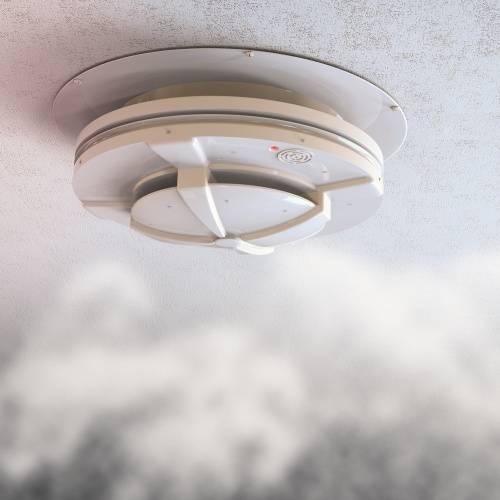

This type of detector is cheaper than the optical detector; however, it is sometimes rejected because it is more prone to false (nuisance) alarms than photoelectric smoke detectors. It can detect particles of smoke that are too small to be visible. It includes about 37 kBq or 1 µCi of radioactive americium-241 (241Am), corresponding to about 0.3 µg of the isotope. The radiation passes through an ionization chamber, an air-filled space between two electrodes, and permits a small, constant current between the electrodes. Any smoke that enters the chamber absorbs the alpha particles, which reduces the ionization and interrupts this current, setting off the alarm.
241Am, an alpha emitter, has a half-life of 432 years. This means that it does not have to be replaced during the useful life of the detector, and also makes it safe for people at home, since it is only slightly radioactive. Alpha radiation, as opposed to beta and gamma, is used for two additional reasons: Alpha particles have high ionization, so sufficient air particles will be ionized for the current to exist, and they have low penetrative power, meaning they will be stopped by the plastic of the smoke detector and/or the air. About one percent of the emitted radioactive energy of 241Am is gamma radiation.